ROCA SUSTAINABILITY

Securing our future today

World Science Day for Peace and Development

World Science Day for Peace and Development invites us to recognize that science is not a luxury but an essential engine for peaceful, equitable and sustainable societies.

By 2025, under the theme “Trust, Transformation and Tomorrow: The Science We Need for 2050”, UNESCO proposes to reflect on the type of science needed to meet the challenges of the coming decades.

In Mexico, this commemoration acquires special relevance in the face of the challenge of better articulating science and technology with the national industrial sector. Although there are advances in innovation, structural weaknesses persist: private investment in science, technology and innovation is low, and the link between academia and business is still limited.

For the Mexican industrial sector, science acts as a basis for implementing emerging technologies that increase competitiveness, efficiency, and sustainability. In this sense, the celebration of the day reinforces the urgency for companies, ESG consultancies and industrial real estate developers to integrate scientific and technological knowledge to better manage risks, optimize processes and contribute to sustainable development.

ASG and Industrial Sector

Global deforestation suffers casualties

Although the rate of global deforestation slowed to about 10 million hectares per year between 2015 and 2020, compared to more than 17 million hectares per year in the 1990s-2000s, this rate is still too high to consider the problem solved.

The most recent assessment by the Food and Agriculture Organization of the United Nations (FAO) in the framework of its Global Forest Resources Assessment (FRA) project confirms that deforestation has slowed down in all regions of the world in the last decade.

According to FAO data, the planet’s forests currently cover about 4.14 billion hectares, which represents about a third of the earth’s surface. Almost half of that total is located in tropical regions, which remain the most vulnerable to forest loss.

However, a much more concerted effort is required to achieve medium- and long-term forest protection objectives. For example, the main drivers include agricultural expansion, grazing, fires, degradation and conversion of forests to other uses.


The report notes that net forest loss (i.e., deforestation minus forest expansion) has also declined: for example, the annual rate of net loss fell from about 7.8 million hectares per year in 1990-2000 to about 4.7 million hectares per year in 2010-2020.

In parallel, annual forest expansion (i.e. new forest areas established or regenerated) has also fallen: from about 9.9 million hectares per year in the period 2000-2015 to about 6.8 million in the next estimated period. Naturally regenerating forests, which account for the vast majority of the world’s forest area – around 90% or more – have seen a net decline of hundreds of millions of hectares between 1990 and 2025, especially in Africa and South America, while Europe has seen a slight increase in this type of cover.

It should be noted that the FRA 2025 report is being prepared with recent data and an improved methodology, but the full publication with all the results will come out at the end of 2025.

Interest rate of the month:

Society is the heart of cities

World Cities Day 2025, organized by UN-Habitat under the slogan “People-Centered Smart Cities”, puts at the center of the debate how technology can improve urban life without leaving anyone behind.

In a context where 70% of the world’s population will live in urban areas by 2050, the event brings together leaders, experts and communities to promote a city model that uses data and digital innovation to strengthen equity, sustainability and resilience.


Specialists agree that a truly smart city is one that puts people at the center, fosters inclusion and turns innovation into a tool to improve well-being and urban justice on a global scale.

ROCA Reports

Securing Our Future Today

Our “Securing Our Future Today” program is a strategic tool that strengthens the relationship with our clients by promoting the responsible management of environmental, social and governance (ESG) issues.


Through this program, tenants benefit by identifying ESG risks and opportunities relevant to their operations, which improves their performance, reduces regulatory and reputational risks, and contributes to their competitiveness in increasingly demanding markets in terms of sustainability.

ESG CULTURE

OUR ADHERENCE TO THE UNITED NATIONS GLOBAL COMPAC

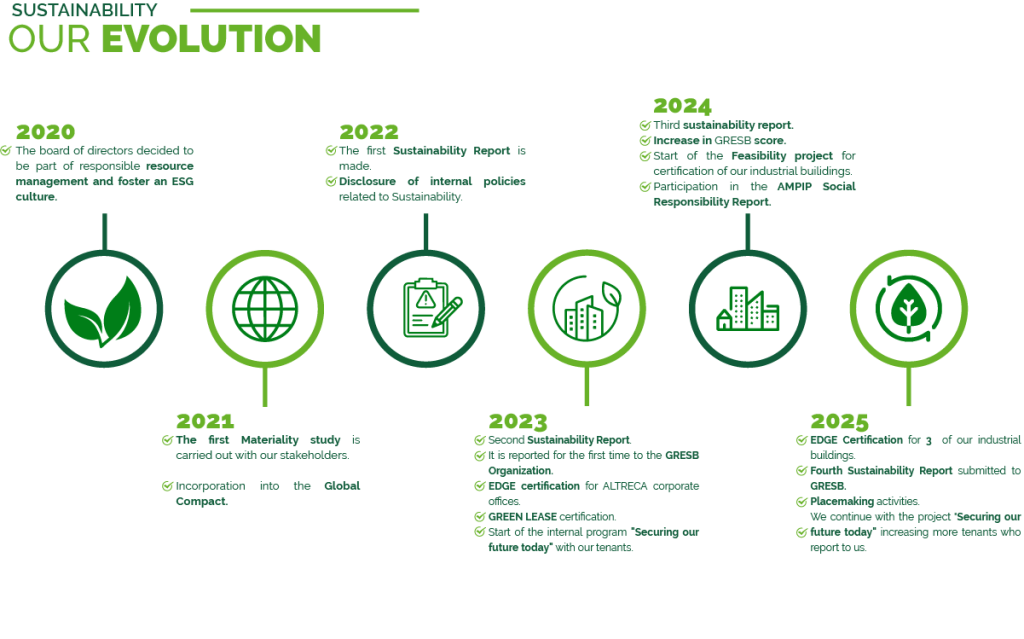
At ROCA Desarrollos, we express our commitment to the implementation and compliance with the Ten Principles of the UN Global Compact. In this regard, we present the link to the official Global Compact website, our COP 2021 report, and our Sustainability and ESG Policy Report.
 

Compare listings

Compare